I was speaking with a person lately who made a significant life decision based on a dream. In the dream, a character told them, “You need to leave,” and when they woke up, they knew that they had to leave their job (without having another one to go to). They sought out counseling to try to discern what to do next in life, but also to be able to tell someone their story because they said that they knew it would sound crazy to other people.
In today’s gospel from Luke 1, we hear the story of Mary, an unwed, Jewish, teenager living in first-century Palestine, who is visited by the angel Gabriel. In this passage called “The Annunciation,” Mary is invited to participate in God’s plan in a way that will have profound ramifications for her life (and the lives of those around her). And she says, “Yes.”
Because of this, Mary became known as Thetokos (which means God-bearer in Greek).
As I have written elsewhere, while Mary’s role in history is a unique and special one, saying yes to being a “God-bearer” in the world is an invitation that each of us receives – over and over again. And often, just like Mary, the invitation comes in a way that may be hard to believe or trust. It’s an inkling, a belief or something inside of us that just tells us that we need to do something or head in a certain direction in life – with little else to go on.
I have always loved the quote from former business executive and social change agent, Peter Block, who once said, “The answer to how is ‘yes.'” As an aside, on Block’s home page, he features a quote from Thomas Merton that says, “Do not depend on the hope of results…In the end it is the reality of personal relationship that saves everything.” I am guessing that Mary knew this in her bones and had a personal relationship with her God that enabled her to, ultimately, release the results and surrender to the process
What I love about Block’s quote is that it highlights receptivity as the initial move that can make things happen. We can actually see Mary getting a little caught up in the “how” when she says, “But how can this happen…” I can imagine that her mind was racing through all the possibilities and why this plan could not work, go wrong, etc.
But instead of getting stuck there, she says, “Yes.” The answer to how is yes.
What I appreciate about this story – and about the scriptures in general – is that they provide testimony as to the kinds of people that God asks to take on so many of the most important roles. People without any significant credentials or social standing. People without formal degrees or adequate preparation. People who have doubts about themselves or doubts about God’s plan. People of all ages.
People like you and me.
All of this runs counter to what our dominant culture offers us, however. We’re told that you need formal degrees, social status, financial backing and a data-driven marketing plan to be taken seriously. And you definitely need to be efficient and effective!
Because of this conditioning, a lot of us have a hard time believing in what is being revealed in our lives.
Our God, however, is not so practical and does not seem too bothered by inefficiency. The one piece of data God seems to be concerned with is receptivity and trust – because in the end, as Merton said, it is all about the relationship. And so God chooses unlikely characters to do some of the most important jobs – characters who will remain in and trust the relationship.
That’s why Mary is such an important role model for us. It’s not about her purity or meekness. It’s about her bold trust in God’s faithfulness, her believing in her own goodness, and her staying true to what is deep inside. We are invited to do the same.
For this week, I want to hold up and honor the risks we take, the random acts of kindness we perform, the intuitions we follow and the acts of justice we pursue – often with only a vague clarity. I know and am inspired by so many people who are trying to do that these days in the face of personal and colective challenges. In each of our lives, there are things that we want to say yes to or have already said yes to that are hard to bear or hard to believe. May we remain faithful to what is emerging in our lives and find the strength and courage to see them through.
Note: If you’re looking to connect more deeply with these Advent stories, please consider joining us on Mondays (December 8, 15 and 22 from 7 – 8:30pm) for our advent reflection series. The 12/8 session will be virtual only (and maybe the other sessions after that as well as almost of the people who have signed up have signed up to attend virtually). If you plan to join us for any of the evenings in the series, please register here.
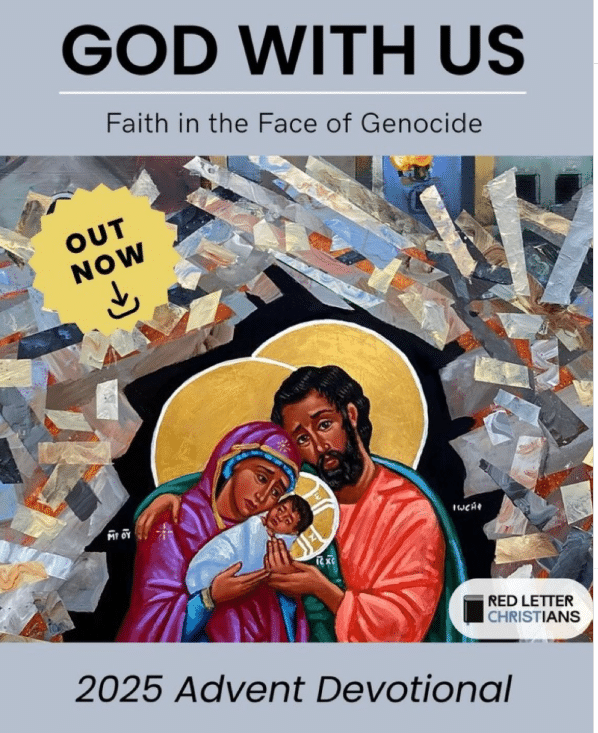
Also, I have been very moved by and appreciated the reflections in an Advent resource called “God With Us: Faith in the Face of Genocide” focused on the ongoing violence in Gaza. You can explore it for yourself here.
One Comment
George Dardess
Thank you again, Mike, for stimulating us to ask important questions of ourselves.
Mary’s “Yes”— I’ve been thinking about her choice while reading one of my favorite authors, William James, who wrote, among many great books, The Will to Believe. James says there, for example:
“The will has as much to do with our beliefs and faith as with our movements. In fact, it is only in consequence of a faith that our movements themselves ensue. We think of a movement and say ‘let it ensue! So far as we are concerned, let it be part of reality!'”
Isn’t this how it was with Mary? How it can be for any of us? We have it in us to change the world, with God’s grace to guide us. Our will to be so guided.
Commenting has been turned off.