Recently when I was in Chiapas, Mexico, we had an opportunity to go to San Cristobal. San Cristobal is the former capital of the state of Chiapas (it changed in 1892). And while the capital changed to and remains in Tuxla-Gurtierrez, San Cristobal remains a cultural and historic center for the region. This is true, in part, due to the strong indigenous presence in that region which was central to what is now known as the Zapatista uprising.
It is beyond the capacity of this blog (well, really the capacity of the author of this blog!) to try to adequately describe the meaning of the Zapatista uprising. But, in short, the Zapatista uprising (which started in 1994 on the first day of the NAFTA treaty) brought numerous indigenous groups together to advocate for their own economic, social and political liberation in a way that upended “business as usual” in Mexico and challenged hundreds of years of oppression and exploitation of the poor and marginalized by wealthy rulers.
Central to the Zapatista vision of liberation was the liberation of women. Women were at the forefront of the movement, and the struggle for women’s equality and freedom were a major part of the Zapatista vision.
When I was in San Cristobal, I happened upon a store that sells products of the Zapatista collectives (yes, they still exist and are active). This was one of the wall hangings that I bought:
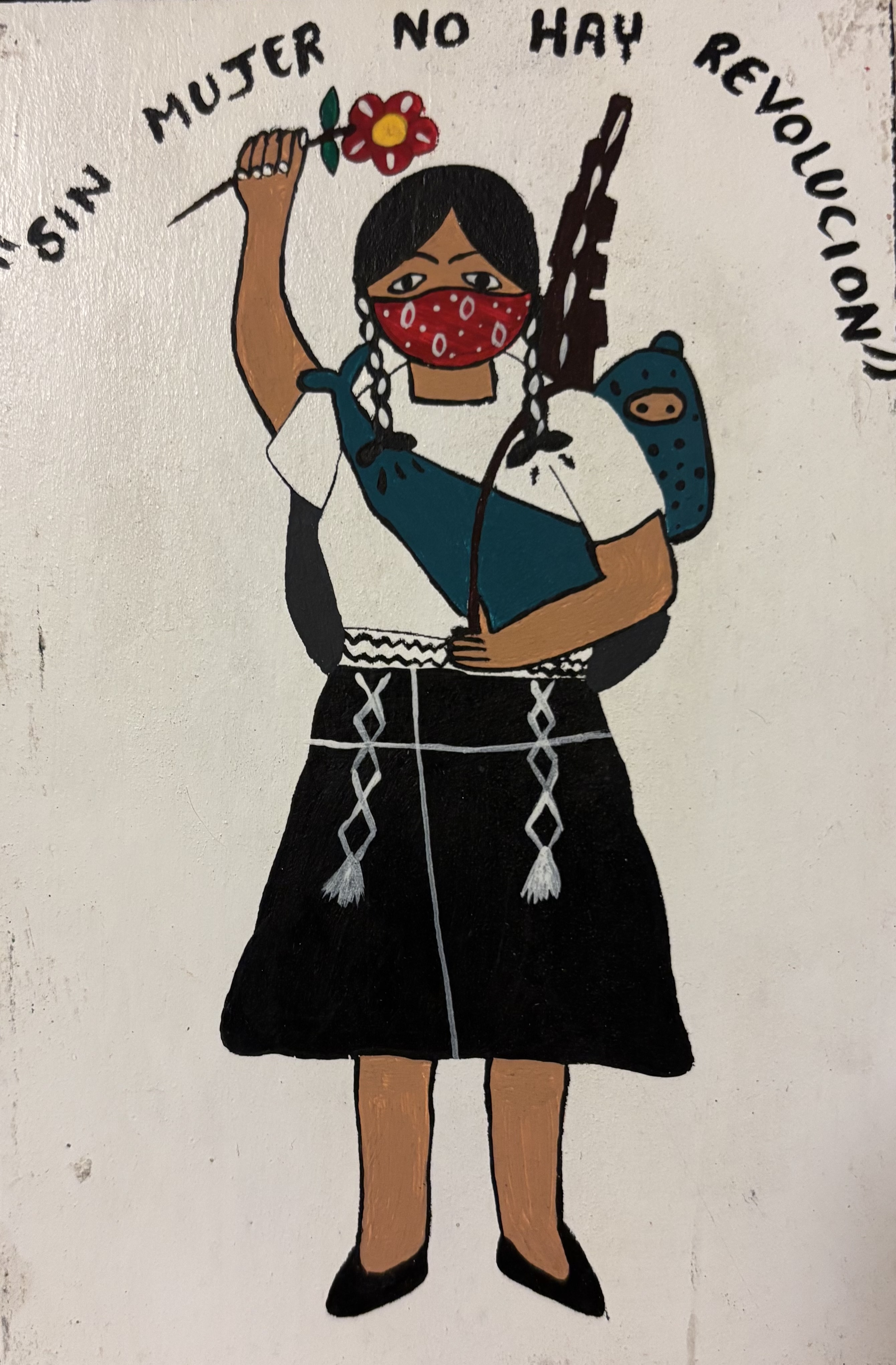
(Photo taken by MB. Translation: Without women, there is no revolution)
Our gospel reading for today is taken from Matthew 1 and we hear what is called Mary’s Magnificat. It is a bold vision for a just world. It is so bold, in fact, that Rebecca Lowe reminds us that
- During the British rule of India, the Magnificat was prohibited from being sung in church.
- In the 1980s, Guatemala’s government found the message of God’s preferential love for the poor (as stated in the Magnificat) to be too revolutionary and dangerous and banned any public recitation.
- In Argentina, after the Mothers of the Plaza de Mayo (the mothers whose children were “disappeared” by the military) protested and placed the Magnificat’s words in public places, the Argentinian military outlawed any of this passage to be publicly displayed.
Wait, was this the Mary that you heard about as a child? I know I didn’t.
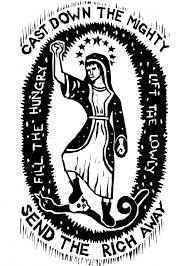
Here’s the essence of the Magnificat: Cast down the mighty. Send the rich away empty. Fill the hungry. Lift the lowly. Imagine if all of our churches recited this every week! And I love how it is captured in an image created by artist Ben Wildflower (please go check out his site and art!).
Throughout history, Mary has been domesticated and neutralized by forces (like patriarchy) that were afraid of her power, afraid of her sexuality and afraid of her centrality in the life of the early church. She has often been portrayed as docile, subservient and silent, in part, because this served the interests of the powers that be.
But this is not the Mary we meet today, and this is not the Mary of history.
I recently came across a rewording of the Magnificat that I found quite stirring. While the original one from Matthew 1 is profound, this one puts some modern language onto her prayer. Theologian and minister, Ryan Kuja, says that “if Mary lived in our country today, she’d be a 14-year-old Black girl struggling to get by in Flint or an adolescent Latina eking out an existence with her immigrant parents in gentrifying El Paso. And her song of praise to the anti-racist and anti-nationalist, pro-poor, and pro-human rights God she worships might read something like this:
I can’t contain my excitement about this! Out of all people, he noticed me, a poor, pregnant teenager! Everyone will call me blessed from now on. God’s love is so much greater than I can even imagine.
He showed his love for everyone, even those society despises,
the LGBTQIA community, immigrants, refugees, the addicted and shamed. God knows black lives matter; refugees and immigrants are his beloved. All the people who are seen as less than human, he knows and loves. He lifts up those who are preyed upon by corrupt politicians, the hungry, the ones brutalized by the police and ICE, and families without healthcare. He invites each of us to the table to speak and tell our story, to be heard and known. The power-hungry perpetrators who care only about their agendas don’t have the last word! I can sense his presence, holding me and all his children close, faithfully liberating us. Just as he promised he would.
Let’s just pause there. What comes up for you when you read this? Was this the Mary you were introduced to? If not, why do you think you did not “meet” her in your faith journey? Wha might it mean now that you have met her and where do you see her energy in our world today?
What is amazing about the Magnificat is that it articulates a whole new social order – with those who have been traditionally excluded being placed at the center of God’s kin-dom.
This is part of the Advent story, and this is part of the work of Advent – to make this vision become more of a reality in our world. It is true that “without women, there is no revolution,” and Mary not only articulated that vision, she was part of it.
I can think of no more important work in the world than supporting those who are working towards Mary’s vision of a world free from gender-based violence, a world of equity and fairness, a world where everyone is respected. And it is so often women and members of the LGBTQIA community who are at the forefront of this work. This is work that we can take up, partner with and support. And if you are a man, supporting, affirming and uplifting the work, role and voices of women is more important than ever (especially as our country is trying to roll things backwards).
The great spiritual writer, Cole Arthur Riley, posted on Instagram a few years ago, “The sound of Advent is the voice of women.” I could not agree more. And she also went on to say, “If your voice has historically taken up too much space, maybe this Advent…practice the silence of solidarity.” This is counsel that we can take up all year long.
3 Comments
Chuck Glatz
After reading so many good blog entries by Mike forwarded to me by Kathy, I thought I’d get on and subscribe myself. Merry Christmas. Chuck
George Dardess
Thanks again, Mike. Yes, Mary as our guide to a world where God, not rulers, are all-in-all— we need constantly to be reminded of her invitation to us.
Another tradition where her invitation is powerfully evoked is the Orthodox Icon tradition, beautifully described in Ponder These Things: Praying with Icons of the Virgin, a short (75 page) booklet by Rowan Williams, the former Archbishop of Canterbury. Williams focuses on three types of icon, the Hodgetria, the Eleousa, and the Orans, helping us see how revolutionary is Mary’s appeal to us in all three types. You can’t sit with these icons long before feeling yourself deeply spoken to and moved to see yourself and the world more clearly.
Sarah Brownell
Yes, we need to stop accepting the world as it is, and take the Zapatista’s lead in making the world we want – “A world where many worlds fit.” I am a big fan of the model of municipalism they demonstrate. Let’s do it.
Commenting has been turned off.